
Origami Skin
How most of your outsides get hidden on the inside.

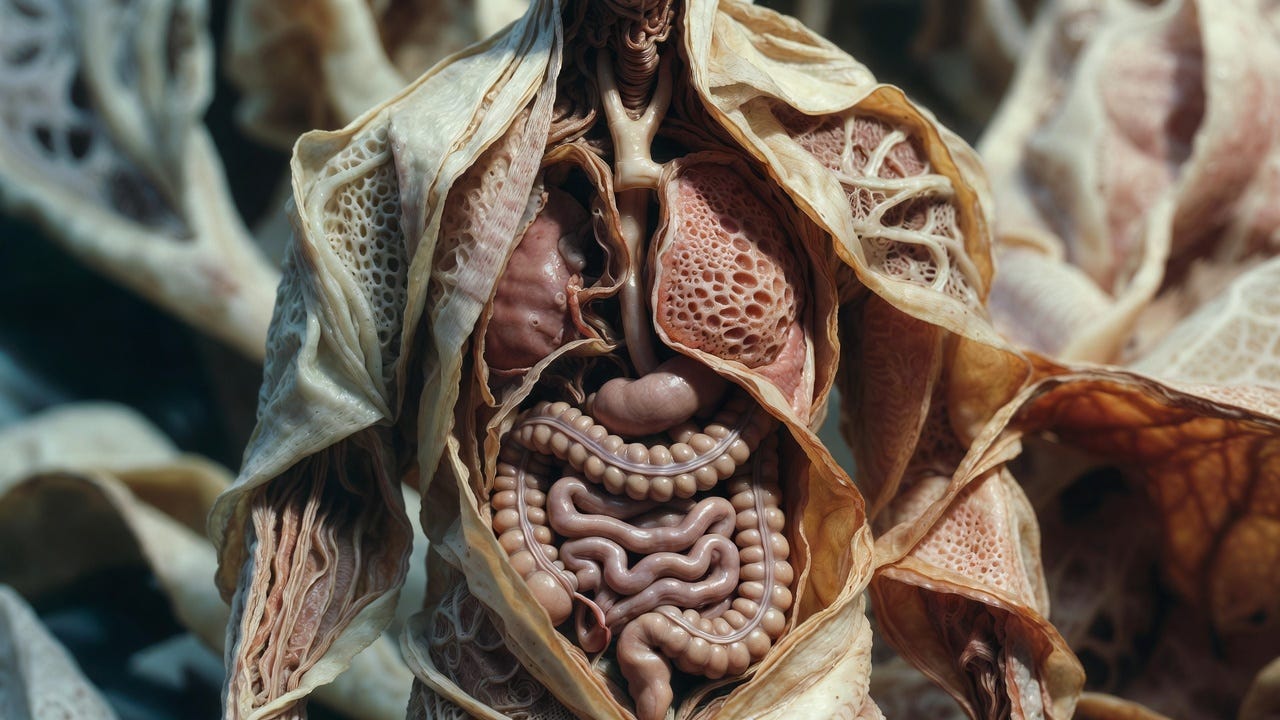
Your skin is much bigger than you think, and most of it is hidden. It has to be.
Also, you’ve got a tube that runs clean through your body. Odd.
You put things in the tube. Stuff comes out the other side. It never feels like part of you.
Cheeseburger in, poop out.
At no point would someone look at what’s in the tube and say, “Yup, that’s me.”
So what gives?
Watch a bacterium eat. Food crosses the membrane and powers the cell.
The membrane does other things, too. Protection, gas exchange, ion management, waste removal, reproduction, you name it. The lining does work. Every organ wrapped into one surface.
But we’re multicellular. Opportunity.
And we’re huge. Challenge.
Volume outstrips surface area as objects grow. Big organisms need big innovation.
Let’s trace your skin.
Start on the middle of your forehead and run straight down your nose, over the philtrum, around the lip and into the mouth.
Hard palate, soft palate, around the corner and up into the sinuses. Mucus and immunity.
Bounce around for a minute and get turned down the back of the throat. Down the esophagus.
Through a door and into the stomach.
This skin leaks acid.
Through another door and then 30 feet of intestine. Thousands of fingerlike projections compound surface area. Flatten it out and reveal just how much is dedicated to breakdown and absorption. Too wet for outside: too delicate.
Another door. Colon.
Then, out the other end.
Back in. Through the reproductive tract, past the ovaries and testes.
Into the bladder. Up the ureter and into the kidney. A delicate filter where your blood touches the outside world.
Back out. Up, over the chin, into the mouth again. Now, the airway.
This is where blood touches air. Dead end in the alveoli—impossibly delicate, gossamer-thin bubbles. Again dedicated to surface area. Again, much safer inside than outside.
Home stretch, back to the forehead. We’ve been everywhere.
One folded surface.
Stretch out what we traced and it sprawls across the floor. A living room rug’s worth of interface for a single person.
Most of it processes nutrition. A little for reproduction and waste management, a whole lot for gas exchange. Some for defense and sensation.
Almost all of it is built on surface area. Only a little is skin as we know it. This is multicellularity’s answer to the cell membrane.
It’s because we’re big. We need more surface to support our massive volume.
Cells stay small because surface area matters. We can be big because we’ve origami’d our skin into ourselves.
Most of our outsides are hidden on the inside, where we chemically dismantle the world by touch.


