
How Worms Discovered Time
Before worms, there was no “over there.”

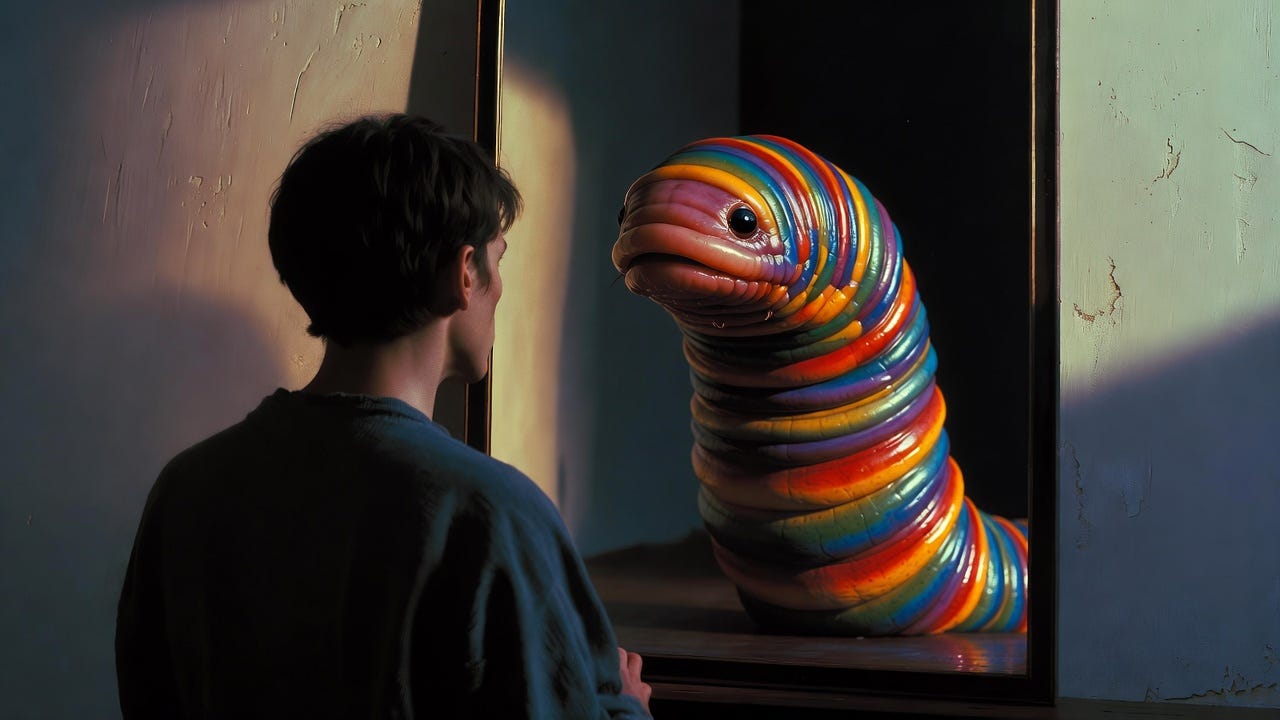
We’re all just worms with fancy bits stapled on.
If you internalize that fact early enough in life, you start noticing things. For one, it’s weird that we show affection by touching mouth parts.
Strip away the legs and hair and you’re basically left with a tube. Food goes in one end, waste out the back. Genitals somewhere in the mix.
Despite all their art, politics, and obsession with TikTok, many humans spend a lot of time securing calories and safety so they can live long enough to create and rear young. Birds and ants seem to be interested in the same things.
It wasn’t always like this.
Let’s build a worm.
First, rewind a few billion years.
For most of life’s history, there was no front or back.
Early life floated, or stuck to things. A tiny world where things like impact, friction, and falling had little meaning.
Life cared less about Newton and more about perfecting the pathways that keep us 47% genetically similar to fruit flies.
Microbes dealt with chemical problems. Drop a little too much fresh water in a briny pool and whole colonies exploded. No time to worry what might happen if a rock falls on you.
But life, sunlight, and time have a history of building complexity. As long as you leave them alone long enough.
So let’s come back in a few billion years, when things start looking more wormy.
600 million years ago.
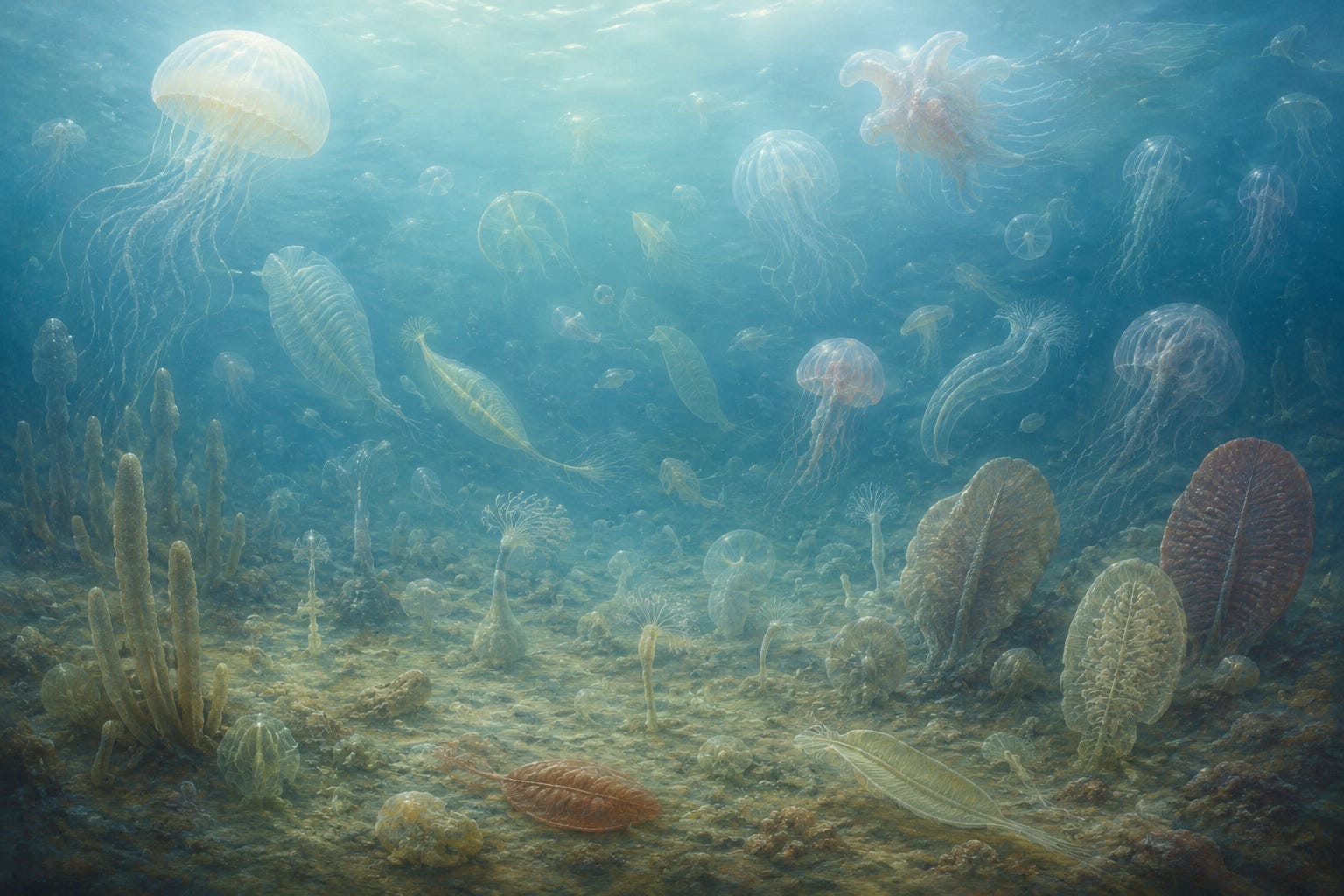
Nerves—life’s information superhighways—started firing by the early Ediacaran, when jellyfish drifted through the seas.
Action potentials transmit information over large distances to many cells at once. Nerves gave animals a command center that could send high-fidelity messages over distance.
Life began running on two scales: DNA controlled the tiny whirs and zips inside cells. Neurons steered the ship, and let the ship get really big.
Modern nerve signals move at ~100 m/s; fast enough for a sauropod to flinch when you step on its tail. Diffusion would take years to decades to do the same job.
Jellyfish Earth probably looked a lot like pre-jellyfish Earth. Except there were jellyfish, and some really interesting UFO-like organisms that descended on microbial mats.
But no vectors. No macroscopic over there.
Then it happened, sometime in the late Ediacaran. Something in the mud—something that knew up from down—moved forward. Toward something. No guessing, no filtering.
That way.
A worm. A tube with a front, back, left, and right. Undulation be damned. Worms could seek. They could follow.
Successfully. Explosively, even.
Worms learned to graze, scavenge, and hunt. They could flee. Maybe even love.
Worms awoke from whirring metabolic machinery and discovered the world we take for granted. The one where we feel water currents, experience gravity, and can duck a punch.
Worms discovered time as we know it.
Catch a ball. Worms did that.
They discovered an empty playing field that had been there all along, hidden by perception. Everywhere around them, other life was stuck in the old way of being. Slow from far away, blindingly fast up close. Totally non-threatening on the scale of meters. Everything became food.
So, evolution did what it always does in a vacuum: It radiated.
Life rushed to fill the world with possibility. Evolution flung spaghetti at the wall. Most of it didn’t stick, but some did.
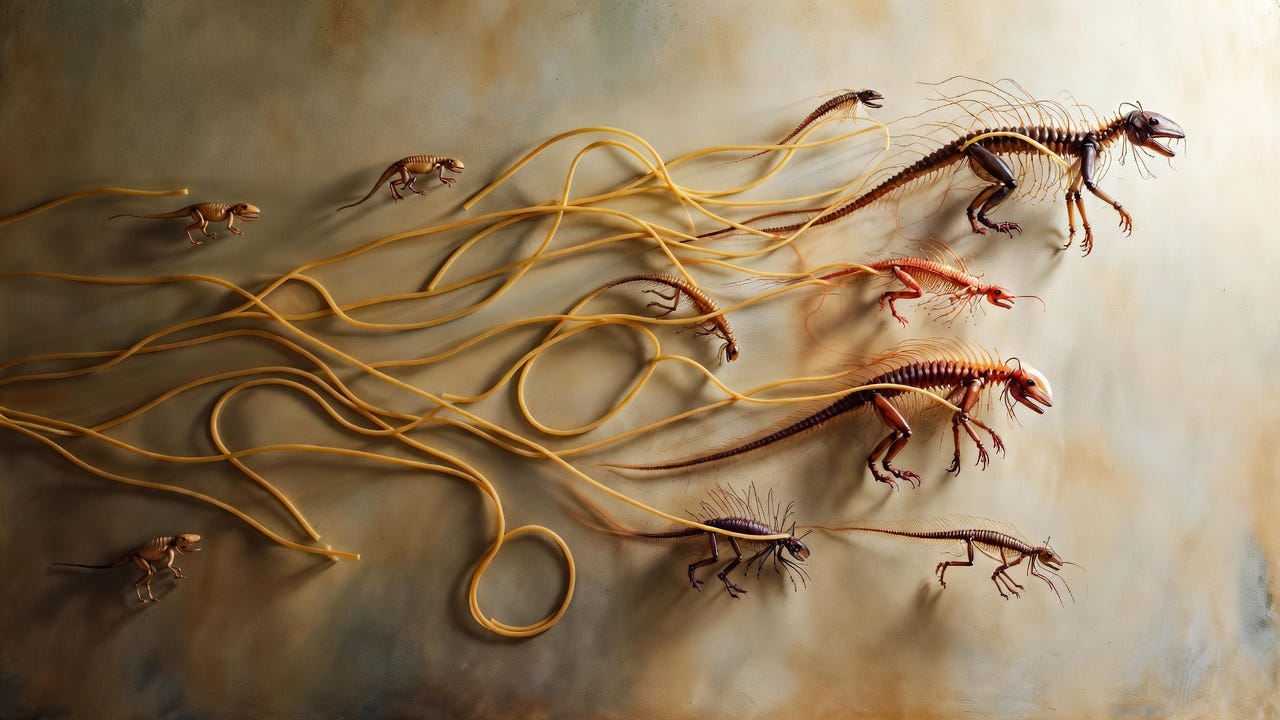
Teeth, pincers, claws, bones, arms, legs, shells. Organs of all shapes and sizes.
Eyes and skin coevolved into an endless menagerie of colors and patterns.
Worms, all.
Humans have thumbs and language and spaceships and war. We move with intent. Our watches tick seconds because rocks take seconds to fall.
We live in a world discovered by worms. A world with direction, and time.
It didn’t have to be this way.
We don’t come from them. We are them.
***Thanks to Josh Chamot for encouraging me to illuminate this manuscript.


So many truths...I often think of myself as my Worm, because I have long had issues with digestion, and it really feels like I am just this worm with stuff wrapped around it... fortunately, all of that is on an improving trajectory, but your opener here hit home!! (Plus, thank you for the shout out!!)
Ok, I simply love this explanation. Super fun.