
Chewing With Rocks
What jalapeño poppers teach us about birds and dinosaurs

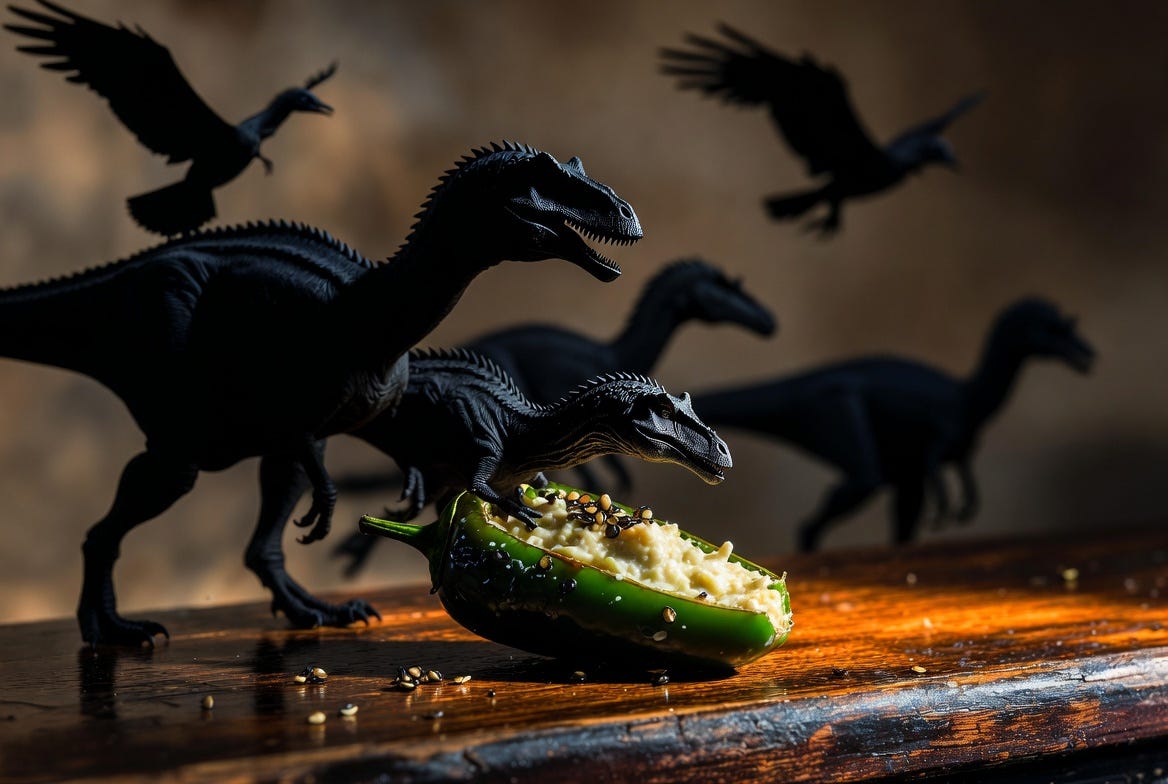
I bit into a jalapeño popper the other night and realized: this plant is trying to tell me something.
It didn’t want me to eat it. But fruit is supposed to be eaten. That meant something else was supposed to. Something that can’t taste capsaicin. A discovery, waiting to happen.
Darwin once predicted the existence of a moth with an incredibly long proboscis because he found a thin, slender flower that demanded it.
The main and probably only difference between me and Charles Darwin is that I have a cell phone.
Birds. Birds can’t taste capsaicin.
Birds often swallow pepper seeds whole, but mammals usually grind them up.
The whole point of fruit is to put seeds in fertilizer.
Mammalian molars are very good at destroying seeds, which simply won’t do if you’re a pepper plant just trying to have babies.
Birds are more of a down-in-one situation. Seeds go in. Oftentimes, seeds come out.
Darwin got famous, and I predicted that birds don’t chew. Another beer, please.
Actually, they do chew. Just not in their mouths.
And not with teeth.
They swallow rocks and use them as grinders. Poorly.
What is even happening? I’ve known forever that chickens swallow rocks, but never spent time unpacking this with an evolutionary lens.
Plants tell you which parts to eat. Fruit is delicious. Leaves are fibrous and usually bitter. Seeds have shells and husks.
If you want to get nutrition from leaves and seeds, you have to break them.
Mammals and dinosaurs cracked this nut in very different ways.
Mammals carry grinders in their heads, and that comes with advantages. Chewing allows the mind to ensure that as much nutrition as possible gets extracted from each bite.
It’s efficient, but when you’re eating, that’s all you’re really doing. And if you’re trying to survive on plants, you’re eating all the time.
Many dinosaurs chose volume. Most teeth tore and chomped, but didn’t grind. Bird ancestors were carnivores built for tearing flesh, not grinding plants. Enormous amounts of food went in, and the stomach was left to do the work.
Enter rocks: the teeth of the stomach.
Dinosaurs with gizzards could eat quickly, then move while digestion caught up.
Which has been helpful for birds. They swallow everything whole and then fly off.
No need for front-heavy chewing muscles. Compatible with a fly-at-any-moment lifestyle.
But a muscular sack and a handful of pebbles don’t grind seeds with the same efficiency as teeth.
Some seeds get through. That’s what matters to a pepper plant.
The heat on a jalapeño popper isn’t a warning. It’s a filter.
The plant wants its fruit to be eaten—just not by you.


Gastroliths. Brings back memories from my dinosaur-obsessed days growing up!